
Beyond the Handover: Why BIM Needs to Live After Construction
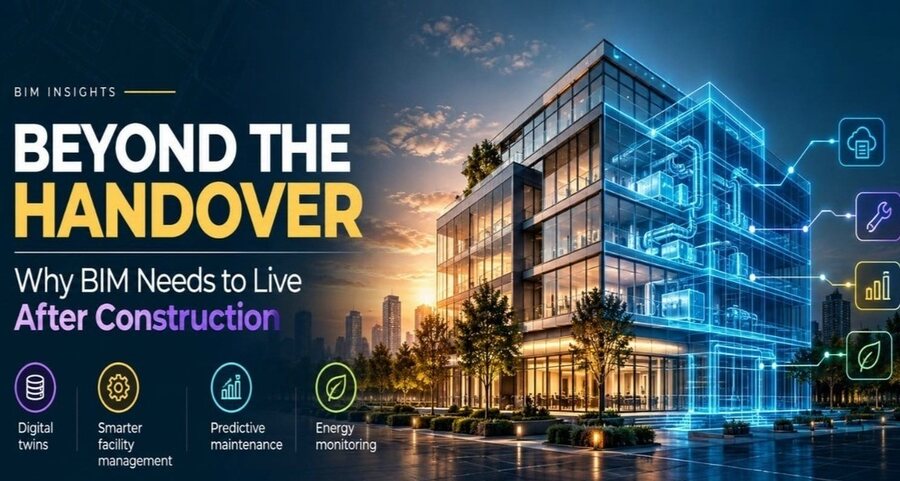
How BIM keeps its value after handover: digital twins, facility management, predictive maintenance, energy monitoring, and the information planning that makes them work.
From a construction model to a living digital asset
In the construction industry, project completion is often celebrated as the finish line. The building is handed over, the keys are delivered, and the construction team moves on to the next project. But what happens to the enormous amount of information generated throughout the building's lifecycle?
For many projects, Building Information Modelling (BIM) plays a crucial role during design and construction, helping architects, engineers, and contractors coordinate their work, identify clashes, and improve project delivery. Yet, once construction is complete, the value of BIM data is not always fully realised.
What if the handover was not the end of BIM, but the beginning of its most valuable phase?
As buildings become more complex and owners demand greater efficiency, BIM is increasingly relevant beyond construction. When accurate, structured, and regularly updated information is connected to facility management processes, it can support smarter operations, better maintenance decisions, and improved building performance.
1. From static models to digital twins
A conventional BIM model represents the physical and functional characteristics of a building. A digital twin takes this concept further by connecting a digital representation with information about the actual asset, potentially including live sensor readings, equipment status, and operational performance.
For example, imagine a commercial building equipped with sensors that monitor indoor temperature, humidity, energy consumption, and equipment performance. When these data sources are integrated with a suitable digital model, facility managers can gain a clearer picture of how the building is operating.
Instead of relying only on drawings or periodic inspections, teams can use connected information to investigate performance issues and make more informed decisions.
However, a digital twin is not created simply by having a 3D BIM model. It requires reliable asset information, appropriate data connections, and processes that keep the digital representation relevant to the physical building.
2. Smarter facility management through BIM
After handover, facility managers are responsible for maintaining the building's systems, equipment, safety, and functionality. Finding the right information at the right time can be challenging, particularly in large commercial buildings, hospitals, airports, and industrial facilities.
A well-prepared BIM model can help bring important asset information together, including:
- Equipment locations and identification numbers.
- Manufacturer details, specifications, and warranties.
- Operation and maintenance manuals.
- Inspection schedules and maintenance history.
- System relationships and access requirements.
- Information needed for repairs, replacements, and renovations.
Consider an air-conditioning unit that stops functioning. Instead of searching through multiple folders for equipment details, a facility manager could use a connected asset record to identify the unit, access its maintenance documentation, and review relevant service information.
The real benefit is not the visual model alone. It is the ability to connect building components with accurate, usable information that supports everyday decisions.
3. Predictive maintenance: addressing problems before they escalate
Traditional maintenance often follows one of two approaches: repairing equipment after it fails or servicing it at predetermined intervals.
Predictive maintenance introduces another possibility: using operational data to identify signs that equipment may be deteriorating.
When BIM asset information is integrated with building management systems, sensor data, and suitable analytics tools, maintenance teams can better understand equipment condition and investigate unusual behaviour.
For instance, a pump showing rising vibration levels or an HVAC system consuming more energy than expected may indicate a developing issue. These signals can prompt further inspection before a minor problem becomes a major disruption.
BIM provides the asset context, while monitoring systems and analytical tools provide operational evidence. Together, they can help maintenance teams prioritise interventions, reduce avoidable downtime, and plan maintenance more effectively.
It is important to recognise that BIM alone does not predict equipment failure. The effectiveness of predictive maintenance depends on data quality, appropriate monitoring, reliable analysis, and competent maintenance practices.
4. Energy monitoring and sustainable building operations
A building's environmental impact does not end when construction is complete. Lighting, heating, cooling, ventilation, and other building systems continue to consume energy throughout the operational phase.
BIM can support energy management by providing information about building geometry, spaces, materials, equipment, and systems. When this information is connected to energy monitoring platforms and building management systems, facility teams can investigate how actual performance compares with design expectations.
For example, unusually high energy consumption in a particular zone may lead to an investigation into HVAC schedules, occupancy patterns, equipment efficiency, or control settings.
This approach can help building owners identify opportunities to:
- Reduce unnecessary energy consumption.
- Improve heating and cooling efficiency.
- Investigate performance gaps between design and operation.
- Support sustainability reporting and energy assessments.
- Make better-informed equipment upgrade decisions.
The key is to move beyond designing an energy-efficient building and establish processes for checking whether that efficiency is being achieved in practice.
5. The handover challenge: information must be usable
Despite its potential, BIM's operational value can be limited when the information delivered at handover is incomplete, inconsistent, outdated, or difficult to access.
A detailed model is not automatically a useful facility management resource. The people operating a building need the right information, presented in a format that supports their actual responsibilities.
This requires planning for asset information from the beginning of the project.
Project teams should establish what information the owner needs, define responsibilities for updating it, agree on data standards, and verify that asset records are accurate before handover. Open information standards and structured asset data can also help improve interoperability between different software platforms.
Just as importantly, facility managers should be involved early enough to influence what information is collected. Delivering thousands of unnecessary data fields adds complexity rather than value.
A successful BIM handover is not about delivering the biggest model. It is about delivering the right information for the building's future.
6. Keeping BIM relevant throughout the building lifecycle
Buildings change continuously. Equipment is replaced, spaces are renovated, systems are upgraded, and operational requirements evolve.
If the digital model is not updated to reflect these changes, it gradually becomes less reliable. Facility teams may then return to disconnected documents and manual records, reducing the value of the original BIM investment.
To keep BIM useful after construction, building owners and project teams should establish a lifecycle information management strategy that includes:
- Define operational requirements early: identify what facility managers need to know about the building and its assets.
- Deliver verified asset information: check equipment data, documentation, identifiers, and relevant model information before handover.
- Connect the right systems: integrate BIM with suitable maintenance platforms, building management systems, or digital twin solutions where beneficial.
- Assign update responsibilities: ensure that replacements, renovations, and other changes are reflected in the relevant records.
- Measure operational outcomes: track indicators such as energy use, maintenance response times, equipment downtime, and asset performance.
The goal is to make building information a dependable resource throughout the asset's useful life, rather than a document that is archived after project completion.
The future of BIM is beyond construction
BIM has already transformed the way many construction projects are designed, coordinated, and delivered. Its next major opportunity lies in helping building owners and operators make better decisions long after the construction team has left the site.
By supporting digital twins, facility management, predictive maintenance, and energy monitoring, reliable BIM information can contribute to more efficient, sustainable, and resilient buildings.
But achieving this future requires more than advanced software. It requires collaboration between designers, contractors, BIM professionals, asset owners, and facility managers, along with a shared commitment to information quality throughout the building lifecycle.
For BIM professionals, this also creates an opportunity to expand their expertise beyond modelling and coordination into asset information management, operational workflows, data integration, and lifecycle thinking.
The real value of BIM should not be measured only by how efficiently a building is constructed, but also by how intelligently it can be operated and maintained.
The next time a project reaches handover, perhaps the most important question is not, “Is the model complete?”
It is, “Will this information continue to create value for the building throughout its life?”
At Bumblebee Inc., we believe that understanding BIM means understanding more than the tools used to create a model. It means understanding how digital construction information can support better decisions across the entire built environment lifecycle.
Courses this relates to
- BIM VANTAGE Course for Civil Engineering: Coordinate multi-discipline civil models across a wider toolset, and take quantity, cost and sustainability analysis through to a delivered project.
- Core BIM Course for Mechanical Engineering: Build the BIM workflow foundations and apply them to mechanical services: HVAC modelling, coordination, data management and delivery.
- Core BIM Course for Civil Engineering: Produce coordinated civil and structural models, drawings, schedules and BOQs, and run basic clash coordination.